
How to Manage Physical Contamination Risks
Food safety management is often discussed through microbiological risks, allergens, sanitation programs, supplier documents, and audit findings. However, one of the most visible and critical risks in food manufacturing is foreign material contamination.
A piece of metal, glass, hard plastic, stone, bone, wood, or equipment fragment found in a food product is not only a quality issue. It can become a consumer safety risk, trigger complaints or recalls, damage brand trust, and lead to serious audit non-conformities.
BRCGS describes foreign bodies as a broad group of potential contaminants, including plastic, glass, metal, wood, stones, bones, insects, soil, and similar unwanted materials. The FDA also states that hard or sharp foreign objects in food may cause injuries to the mouth, throat, stomach, and intestine.
For this reason, foreign material control should not be seen as a final-line metal detection activity only. An effective system requires risk assessment, preventive controls, equipment maintenance, visual inspections, employee awareness, complaint management, CAPA records, and digital traceability.
What Is Foreign Material Contamination?
Foreign material contamination refers to the presence of physical materials in food that should not be there. These materials may come from raw materials, equipment, packaging, employees, the production environment, maintenance activities, or process failures.
Codex food hygiene principles define contaminants as biological, chemical, or physical agents, foreign matter, or other substances not intentionally added to food that may compromise food safety or suitability.
Common physical contamination sources in food manufacturing include:
- Metal fragments
- Glass pieces
- Hard plastic fragments
- Wood splinters
- Stones or soil residues
- Bone fragments
- Packaging material residues
- Equipment parts such as screws, seals, wires, or blade fragments
- Employee-related items such as jewelry, hair, nails, or personal objects
Not every foreign material risk has the same severity. Product type, consumer group, process step, detection equipment, and the size or shape of the object all influence the risk level.
Why Is Physical Contamination a Critical Food Safety Risk?
Physical contamination may sometimes appear to be a visual quality problem. However, hard, sharp, or swallowable objects can directly harm consumers. The FDA describes HACCP as a food safety management system based on the analysis and control of biological, chemical, and physical hazards.
Foreign material risks may result in:
- Consumer injuries
- Customer complaints
- Product recalls
- Audit non-conformities
- Legal or commercial consequences
- Loss of brand trust
- Retailer or customer contract risks
- Production downtime and rework costs
In high-volume food manufacturing, even one small physical contamination incident can trigger a significant risk management process. This is why foreign material control should be preventive rather than reactive.
Where Do Foreign Material Risks Come From?
To manage foreign material risks effectively, food manufacturers first need to understand the source. If an incident is treated only as “a piece was found in the product,” the real root cause may remain hidden.
1. Raw Material and Supplier-Related Risks
Some foreign materials may enter the facility through raw materials. Agricultural products may contain stones, soil, stems, insects, or natural residues. Meat products may contain bone fragments. Dry ingredients may carry hard particles or foreign objects from harvesting, transportation, or storage.
This makes supplier approval, incoming quality checks, and raw material acceptance criteria important parts of foreign material control.
2. Equipment and Maintenance-Related Risks
Metal fragments, seal pieces, blade tips, plastic parts, wires, and screws from production equipment may create serious physical contamination risks. The risk increases when post-maintenance cleaning, line clearance, or restart checks are not properly performed.
This is where maintenance data and food safety data should be evaluated together. If a line has frequent equipment failures and foreign material complaints increase in the same period, the issue is not only a quality department concern. It requires joint action from maintenance, operations, and food safety teams.
3. Glass and Brittle Plastic Risks
Lighting, gauges, covers, measuring devices, panels, and certain production-area materials may contain glass or brittle plastic. If these materials break, small fragments may enter the product or production environment.
A strong control program should include a glass and brittle plastic inventory, regular area inspections, breakage procedures, and post-incident cleaning and verification records.
4. Employee and Operational Risks
Jewelry, pen caps, glove pieces, hair clips, cleaning tools, and personal items may create contamination risks in production areas. Written procedures are not enough on their own. Employee awareness, operational discipline, and regular observation records are also necessary.
Common Problems in Manual Control Processes
In many food manufacturing facilities, foreign material control is still managed through Excel files, paper forms, emails, and manual follow-ups. This may seem manageable in daily operations, but it can create serious challenges during audits, complaints, or crisis situations.
| Control Area | Problem in Manual Processes | Value of a Digital FSMS |
| Metal detector records | Missing or hard-to-read records | Standardized, traceable records |
| Glass/plastic inventory | Outdated lists | Periodic checks and reminders |
| Foreign material complaints | Scattered email follow-up | Root cause and CAPA connection |
| Post-maintenance checks | Quality and maintenance records are separated | Shared data for better decisions |
| Audit readiness | Evidence collection takes time | Records are accessible in one system |
| Trend analysis | Risks are noticed late | Analysis by site, line, product, and period |
The biggest issue with manual processes is not always the absence of data. Often, the data exists but cannot be transformed into meaningful insight.
The Role of Metal Detection, X-Ray, and Visual Inspection Records
Metal detectors, X-Ray systems, sieves, magnets, filters, and visual inspections are important tools in foreign material control. However, installing these systems is not enough.
Food safety teams should regularly ask:
- Are test checks performed at the planned frequency?
- What happens when a test fails?
- How are rejected products separated and recorded?
- Is detection sensitivity appropriate for the product type?
- Are parameters updated during product or line changes?
- Can control records be easily presented during audits?
A metal detector or X-Ray system becomes a real food safety control point only when it is managed together with verification records, corrective actions, and trend analysis.
Root Cause Analysis in Foreign Material Incidents
When foreign material is found, quick action is important. However, separating affected product or responding to the customer is not enough. The key question is:
How, where, and why did this material enter the product?
An effective root cause analysis should evaluate:
- Product and batch information
- Production line
- Production date and shift
- Related equipment
- Recent maintenance activities
- Metal detector or X-Ray records
- Raw material supplier
- Packaging material
- Employee observation records
- Previous similar complaints
- Audit findings
- CAPA history
This approach helps teams treat foreign material incidents not as isolated problems, but as indicators of system-level risk.
How a Digital FSMS Strengthens Foreign Material Control
A digital Food Safety Management System turns foreign material control into more than a recordkeeping process. It centralizes data, connects related risks, and helps teams make faster and more informed decisions.
With a digital FSMS, food manufacturers can manage:
- Centralized foreign material incident records
- Traceability by product, batch, line, and location
- Metal detector and X-Ray control records
- Glass and brittle plastic inspection plans
- Post-maintenance hygiene and line clearance forms
- Customer complaint and CAPA connections
- Trend analysis for recurring incidents
- Audit evidence in one accessible system
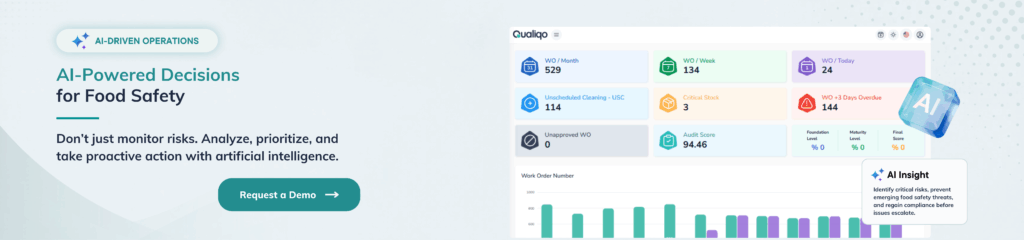
- AI-supported analysis for hidden risk patterns
This structure helps quality teams move beyond “what happened?” and start answering “why is it recurring?” and “which line is becoming riskier?”
Seeing Hidden Risk Trends with AI-Supported Analysis
Foreign material incidents may sometimes appear isolated or random. However, when data is analyzed together, specific patterns may become visible.
For example:
- Complaints may increase after maintenance activities on a specific line.
- Similar physical residues may appear in raw materials from the same supplier.
- Metal detector rejection records may increase for a certain product group.
- Glass or brittle plastic issues may recur in the same location.
- Visual inspection gaps may be concentrated in specific shifts.
AI-supported analysis can bring these scattered signals together and provide food safety teams with a clearer risk picture. The goal is not to replace human decision-making. The goal is to support faster, more preventive, and data-driven decisions.
Make Foreign Material Control Preventive, Not Reactive
Foreign material contamination is one of the most visible and sensitive risks in food manufacturing. It directly affects consumer safety, audit performance, brand trust, and operational continuity.
However, effective control is not limited to final-line detection. Real control requires supplier management, maintenance records, process checks, employee awareness, complaint management, CAPA, audit findings, and trend analysis to work together.
A digital FSMS makes foreign material control more traceable, measurable, and preventive. Instead of simply reacting to incidents, food manufacturers can identify risks earlier, analyze recurring issues, and build a stronger food safety culture.
Qualiqo helps food manufacturers centralize, analyze, and improve food safety processes through a data-driven FSMS approach.

Next Steps
For food companies seeking efficiency, Qualiqo offers a reliable, all-in-one sanitation management solution. Qualiqo is designed to streamline food safety and sanitation processes for better operational control. It helps businesses track cleaning schedules, verify tasks, and meet food safety standards. Features include audit management, real-time alerts, and complete traceability across operations. With Qualiqo, food businesses embrace digital transformation and reinforce their food safety commitment.
Did you get enough information about “Foreign Material Control in Food Manufacturing?”
Qualiqo is here to help you. It answers your questions about sanitation and hygiene, Lab. & EMP, IPM and Pest Control. We also provide information about the main features and benefits of the software.
We help you access the Qualiqo demo and even get a free trial.