
Are You Cleaning Too Much? Rethinking Fixed Sanitation Frequencies in Food Manufacturing
In food manufacturing, cleaning more often can feel like the safest possible approach.
If an equipment surface is cleaned every shift, why question it? If a sanitation task has been scheduled every eight hours for years, changing that frequency may seem unnecessary—or even risky.
But there is another question worth asking: Why is it cleaned every eight hours in the first place?
Was the frequency established based on contamination risk, historical sanitation performance, ATP results and environmental monitoring data?
Or has the same schedule simply been carried forward year after year?
Food safety programs must always protect product safety first. But that does not mean every sanitation activity needs to occur at the highest possible frequency.
Some areas may be cleaned more often than necessary, consuming labor, chemicals, water and production time without creating a measurable improvement in hygiene performance.
At the same time, other higher-risk areas may require more frequent attention than their existing schedule provides.
This is where sanitation frequency optimization becomes valuable.
The objective is not to clean less.
It is to determine when cleaning is actually needed based on risk and evidence.
The Problem With “We Have Always Cleaned It This Way”
Fixed sanitation schedules are essential for operational consistency. They ensure that cleaning activities are planned, assigned and completed at defined intervals.
The problem begins when frequency becomes disconnected from actual performance.
Consider two pieces of equipment.
Both are scheduled for cleaning every eight hours.
However:
- Equipment A consistently passes visual inspection, ATP verification and environmental monitoring.
- Equipment B repeatedly generates elevated ATP results and corrective sanitation activities before the eight-hour interval is complete.
Should both assets continue to have exactly the same cleaning frequency?
Probably not.
A fixed schedule treats both situations identically, even though their actual hygiene performance is different.
This is why sanitation frequency should not be viewed as a permanent number.
It should be a control parameter that can be periodically evaluated using evidence.
The question changes from: “Did we perform the scheduled cleaning?” to: “Is this schedule still appropriate for the actual risk and performance of this equipment?”
That is a much more useful question for modern food safety management.
What Does Over-Cleaning Really Cost?
Unnecessary sanitation does not only affect the sanitation team.
Every cleaning activity can involve several operational resources:
| Area | Potential Impact of Unnecessary Cleaning |
|---|---|
| Labor | Additional sanitation hours and overtime |
| Chemicals | Increased detergent and sanitizer consumption |
| Water | Higher water usage |
| Production | Additional downtime or reduced production availability |
| Equipment | Increased wear from repeated cleaning or disassembly |
| Maintenance | More intervention related to seals, fittings or components |
| Waste | Additional chemical, water and cleaning-material waste |
These costs can become significant when the same unnecessary activity is repeated across hundreds of sanitation tasks throughout the year.
There can also be less visible consequences.
Repeated wet cleaning, for example, may introduce additional moisture into areas where moisture control is important. Frequent equipment disassembly can also increase handling and mechanical wear.
None of this means that sanitation frequency should simply be reduced to save money.
Food safety requirements must always come first.
But it does mean that “more frequent” should not automatically be treated as synonymous with “better.”
The best sanitation frequency is the one that provides sufficient control for the actual risk.
Under-Cleaning Is the Other Side of the Same Problem
Sanitation optimization works in both directions.
If unnecessary cleaning creates cost and inefficiency, insufficient cleaning can create a much more serious problem: increasing food safety risk.
Imagine an asset scheduled for cleaning every 24 hours.
Historical data begins showing:
- More frequent ATP warnings after 18–20 hours
- Repeated sanitation corrective actions
- Increased residue observations
- Recurring environmental monitoring concerns in the same area
The sanitation schedule may technically still be followed exactly as written.
But the data suggests that the current frequency is no longer sufficient.
In this situation, optimization could mean increasing cleaning frequency.
This is why risk-based sanitation should never be reduced to a cost-cutting exercise.
The objective is to identify where sanitation resources are being used unnecessarily and where additional control may actually be needed.
A more mature sanitation program therefore asks two questions at the same time:
Where are we cleaning more frequently than the evidence requires? and Where are we not cleaning frequently enough to maintain consistent control?
What Data Should Influence Sanitation Frequency?
A sanitation schedule should not be changed based on a single result.
One failed ATP reading does not automatically mean an entire sanitation frequency should be increased.
Likewise, several successful results do not automatically justify reducing cleaning frequency.
Decisions should be based on consistent historical evidence and risk assessment.
Useful information may include:
ATP Verification Results
Repeated ATP results can help reveal whether hygiene performance remains consistently controlled throughout the period between cleaning events.
More importantly, trends matter.
A result may technically pass while gradually moving closer to the established limit.
Environmental Monitoring Data
EMP results can provide additional information about microbiological conditions within production environments.
Recurring findings associated with a particular zone, asset or location may indicate that sanitation frequency or sanitation methodology requires review.
Sanitation Work Order History
Historical work orders can show:
- How frequently corrective cleaning is required
- Which assets repeatedly fail verification
- Whether cleaning tasks are consistently completed
- Whether certain sanitation procedures create recurring issues
Visual Inspection and Verification
Not every useful signal is microbiological.
Repeated residue, product buildup or cleaning-accessibility issues can help determine whether a sanitation interval remains suitable.
Product and Process Risk
Cleaning frequency should also consider factors such as:
- Product characteristics
- Allergen changeovers
- Equipment design
- Production duration
- Temperature and moisture
- Hygienic zones
- Historical contamination risk
No single dataset should determine the schedule independently.
The strongest decisions come from combining operational history with food safety expertise.
From Fixed Schedules to Risk-Based Sanitation
Traditional sanitation scheduling might look like this:
Equipment → Frequency → Work Order → Completion
A more data-driven model adds another layer:
Equipment → Risk → Frequency → Performance → Verification → Historical Analysis → Frequency Review
This creates a feedback loop.
Instead of sanitation frequency remaining unchanged indefinitely, actual performance can help teams evaluate whether the schedule remains appropriate.
For example:
Scenario A
An equipment group has maintained highly consistent sanitation verification results over an extended period. There are no recurring sanitation-related findings, and historical ATP and environmental results remain stable.
The food safety team may determine that the frequency deserves further risk-based evaluation.
Scenario B
Another asset experiences repeated verification issues shortly before scheduled sanitation.
Historical analysis suggests that performance deteriorates consistently after a certain production duration.
The team may consider increasing the frequency or investigating the sanitation method.
In both cases, the system supports the decision.
The decision itself remains controlled by qualified food safety professionals.
That distinction is important.
Optimization should support expert judgment not replace it.
How AI Can Support Sanitation Frequency Optimization
As sanitation programs become larger, manually analyzing years of work orders, verification results and recurring failures becomes difficult.
This is where AI-supported analysis can become useful.
Instead of asking a Food Safety Manager to manually review thousands of historical sanitation records, an intelligent system can help identify patterns such as:
- Assets with consistently successful sanitation histories
- Equipment with repeated verification failures
- Locations requiring frequent corrective sanitation
- Differences between planned frequency and actual hygiene performance
- Recurring issues associated with specific sanitation activities
- Potential candidates for sanitation frequency review
The key word is recommendation.
AI should not independently decide that a critical sanitation activity can suddenly move from daily cleaning to weekly cleaning.
Rather, it can analyze historical information and highlight areas where human review may be valuable.
This creates a practical workflow:
Historical Data → Pattern Detection → Recommendation → Food Safety Review → Approved Adjustment → Continued Verification
Any adjustment should then continue to be monitored.
If performance deteriorates, the frequency can be reviewed again.
Sanitation therefore becomes a dynamic process rather than a schedule that is created once and rarely challenged.
Building Smarter Sanitation Programs With Qualiqo
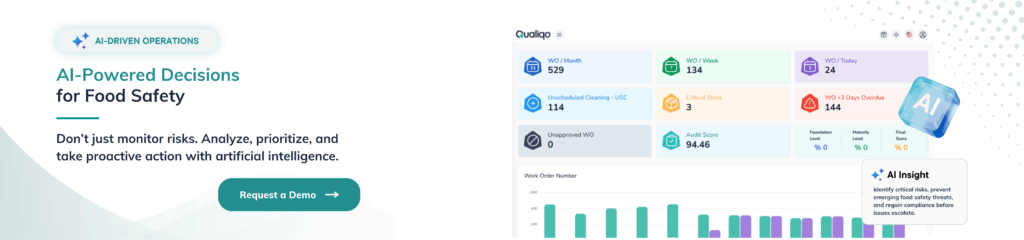
Qualiqo helps food safety teams manage sanitation activities in a structured digital environment, creating historical records that can be used for more than documentation.
When sanitation work orders, verification information and related food safety data are digitally available, organizations gain a stronger foundation for evaluating sanitation performance over time.
With AI-supported sanitation frequency optimization, historical work orders and results can help identify patterns and support recommendations for frequency review.
Instead of applying the same logic to every asset, teams can focus on the actual performance and risk associated with individual sanitation activities.
The goal is not simply: Clean less. And it is not: Clean more.
It is: Clean at the right time, for the right reason, based on the right evidence.
That is the difference between maintaining a sanitation schedule and continuously improving a sanitation program.
The Question Food Safety Teams Should Start Asking
Sanitation programs naturally focus on whether cleaning has been completed.
But mature programs should also periodically question whether the schedule itself is still correct.
- Why is this equipment cleaned every four hours?
- Why is that area cleaned once per week?
- What evidence supports those frequencies?
- Has performance changed?
- Are we repeatedly cleaning equipment that consistently demonstrates stable hygiene performance?
- Are we waiting too long to clean areas that repeatedly generate problems?
Historical sanitation data can help answer those questions.
And as digital FSMS platforms make that information easier to analyze, sanitation frequency can evolve from a static schedule into a risk-based and continuously evaluated control strategy.
Because effective sanitation is not about performing the greatest possible number of cleaning activities.
It is about maintaining the right level of control.
Next Steps
For food companies seeking efficiency, Qualiqo offers a reliable, all-in-one sanitation management solution. Qualiqo is designed to streamline food safety and sanitation processes for better operational control. It helps businesses track cleaning schedules, verify tasks, and meet food safety standards. Features include audit management, real-time alerts, and complete traceability across operations. With Qualiqo, food businesses embrace digital transformation and reinforce their food safety commitment.
Did you get enough information about “Sanitation Frequency Optimization in Food Manufacturing?”
Qualiqo is here to help you. It answers your questions about sanitation and hygiene, Lab. & EMP, IPM and Pest Control. We also provide information about the main features and benefits of the software.
We help you access the Qualiqo demo and even get a free trial.
Frequently Asked Questions
Sanitation frequency optimization is the process of evaluating how often cleaning activities should occur using food safety risk, historical sanitation performance and verification data rather than relying only on fixed historical schedules.
Not necessarily. Optimization may identify some activities that could be reviewed for reduced frequency, while other high-risk areas may require more frequent sanitation. The objective is to establish an appropriate frequency based on risk and evidence.
Food manufacturers may consider sanitation work order history, ATP verification results, environmental monitoring data, corrective cleaning records, visual inspection results, equipment characteristics, product risk and historical food safety performance.